UK electrician jobs in New Zealand: why EWRB registration matters as much as the job offer
Tips · 2026-10-29 · 10 min read
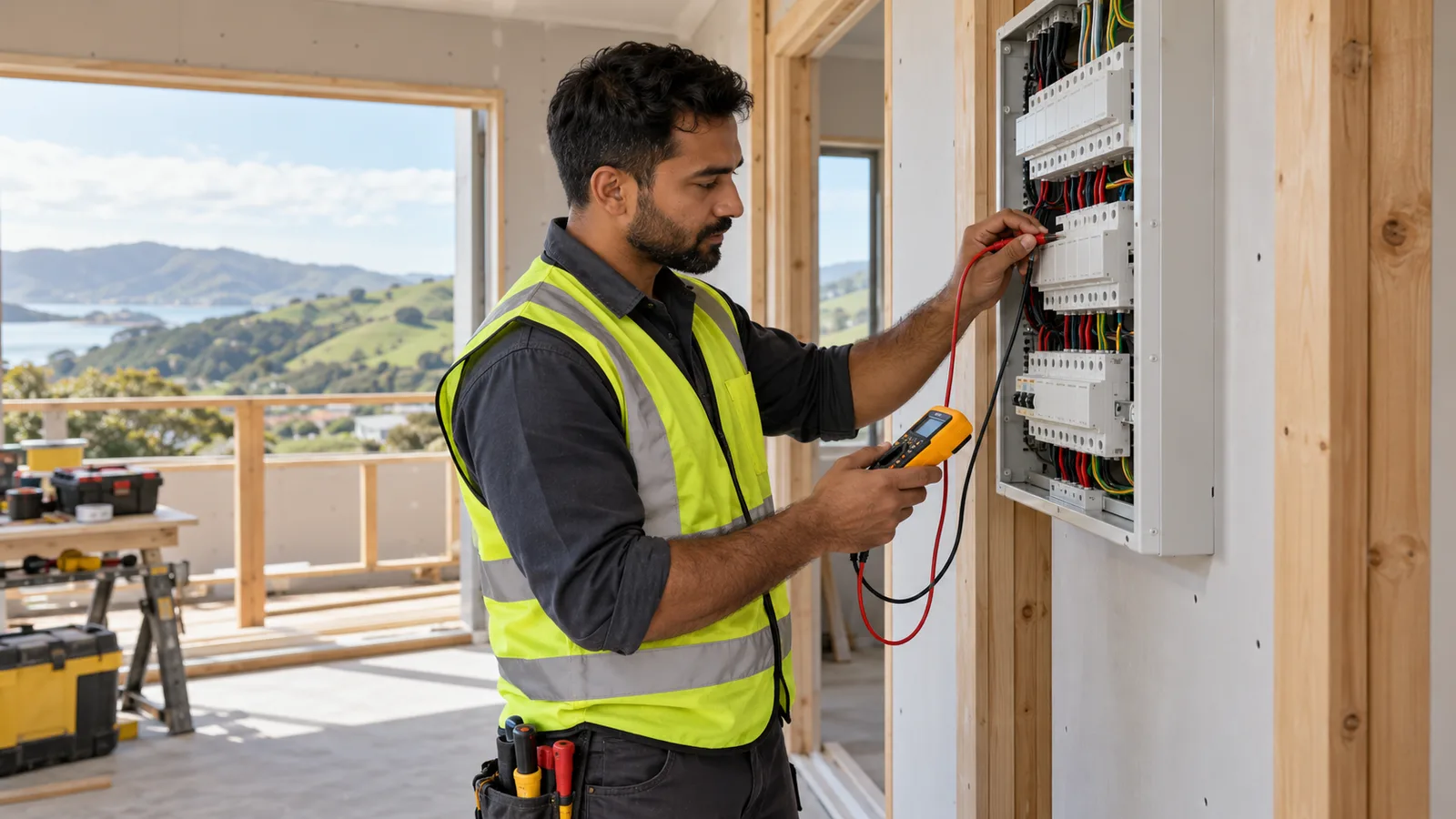
UK electrician jobs in New Zealand come with two separate checks, and the visa is only one of them. Before you can work on the tools there, the Electrical Workers Registration Board (EWRB) has to register you in the right class, and you must hold a Limited Certificate before you can apply for a Practising Licence. On the visa side, most sponsored roles go through the Accredited Employer Work Visa (AEWV), which starts with an offer from an accredited employer. Answer the registration question early, before you send a single application.
Two checks, two different bodies
Picture two tracks side by side: one decides whether you may do electrical work in New Zealand, the other whether you may live and work there at all.
gov.uk's Living in New Zealand guide puts it in plain terms: to work there you need a work visa and an IRD number, you may need to register in your occupation and provide a UK criminal records check (a DBS check), and you may need your qualifications recognised by the New Zealand Qualifications Authority (NZQA). For an electrician, "register in your occupation" is not optional. It is the EWRB.
| Check | Who decides | What it means for a UK electrician |
|---|---|---|
| Electrical registration | Electrical Workers Registration Board (EWRB) | Apply for registration in the right class, hold a Limited Certificate, then apply for a Practising Licence |
| Work visa | Immigration New Zealand (INZ) | Usually the AEWV, which needs an offer from an accredited employer with an approved job check |
| Skills for the visa | INZ | 2 years or more of relevant experience, or a level 4+ qualification on New Zealand's framework |
| Criminal record | Employer and INZ | A DBS check may be asked for by employers; INZ asks applicants to check whether police certificates are needed |
| Tax number | Inland Revenue (IRD) | An IRD number, free to apply for and kept for life |
EWRB registration: the right class and a Limited Certificate first
The EWRB is the body that registers electrical workers in New Zealand. Its page for overseas-trained applicants sets out the order: you apply for registration in the right class, you hold a Limited Certificate, and only then can you apply for a Practising Licence.
"The right class" is the part to read slowly. The class should match the work you actually do, not the job title on your last payslip: an installation electrician and a maintenance sparky in a factory may not fit the same box. The Limited Certificate is a stepping stone, not the finish line, so anything the board's page does not answer, ask the board directly rather than relying on a forum or a recruiter's summary.
If you have weighed up Australia too, you will notice the systems are not shared. Our guide on why UK electricians face a skills assessment first and a state licence later in Australia shows how different the other side of the Tasman is.
Your UK qualifications and the AEWV skills rule
gov.uk lists an advanced apprenticeship and a level 3 NVQ as level 3 qualifications in England, Wales and Northern Ireland. In Scotland, SVQs are work-based qualifications assessed in the workplace against national occupational standards.
The AEWV skills rule uses New Zealand's scale. INZ asks for 2 years or more of relevant job experience, or a qualification at level 4 or higher on the New Zealand Qualifications and Credentials Framework (NZQCF), in the same field as the job. The UK and New Zealand scales are not like-for-like.
For most qualified electricians the simpler route is the experience limb. Keep references showing your dates and the electrical work you did. For a formal comparison, NZQA's International Qualification Assessment (IQA) compares an overseas qualification with New Zealand ones; NZQA says average waits are now 10 weeks.
The job offer: what an accredited employer has to have in place
The AEWV is built around the employer. It is for people with a job offer from an accredited employer, and the employer sends you the link to the online application form.
The AEWV page on immigration.govt.nz lists what the offer itself must meet:
- at least 30 hours of work a week;
- an accredited employer that holds an approved job check for that exact role;
- pay of at least the market rate for the job;
- an employment agreement with no unlawful deductions, no trial period and no unacceptable bonding clauses.
You can check the business yourself on INZ's accredited employer list. Search by the company or trading name, or by its 13-digit New Zealand Business Number (NZBN); INZ updates the list daily. Some accredited employers choose not to appear in search results, so if a firm is missing, ask it in writing to confirm its accreditation before you go further.
Our five checks to run on an AEWV job offer before you say yes goes through the offer letter line by line, and the full AEWV guide for people in the UK covers the visa from start to finish.
English, length of stay and the longer view
If the job sits at ANZSCO or NOL skill level 3 to 5, INZ says you must show you can speak and understand English, and any test result must be no more than 2 years old. Skill level 1 or 2 jobs do not need this. Check where your role sits before booking a test you may not need.
The AEWV costs from NZD $1,540 and can let you stay up to 5 years depending on the job. Total time on one or more AEWVs is 5 years for most jobs, or 3 years for skill level 4 or 5 jobs, after which you normally need 12 months in a row outside New Zealand.
If you hope to stay for good, the Skilled Migrant Category has a Trades and Technician pathway. INZ says it needs a relevant qualification and at least 4 years of post-qualification experience, including at least 18 months of skilled work in New Zealand. A temporary visa does not promise residence, so plan the first few years on their own merits.
What it costs, roughly, in pounds
The pound figure for the visa is a rough comparison using the Reserve Bank of Australia rates published on 22 October 2026; rates change, so check again before you pay.
| Item | Official cost | Rough guide in pounds |
|---|---|---|
| Accredited Employer Work Visa | From NZD $1,540 | About £654 |
| Basic DBS check (England and Wales) | £20 | £20 |
| ACRO Police Certificate, one copy | £70 | £70 |
| IRD number | Free | Free |
| EWRB registration and certificate | See the EWRB page | Check before you apply |
A basic DBS check usually takes up to 3 days. ACRO says its certificate can take up to 20 working days and advises you not to book travel or start a job until it arrives. Not sure which record to order? Our comparison of the DBS check and the ACRO police certificate explains each one.
Step by step: from a UK job to a New Zealand switchboard
- Read the EWRB's overseas page first. Work out which registration class matches the work you actually do and note the evidence it asks for.
- Gather your proof. Apprenticeship records, NVQ or SVQ certificates, and employer references with dates and duties. Keep the originals safe and have clear scans ready to send.
- Update your CV for New Zealand. Lead with the installations you have worked on and your years in the trade. Build AI CV can help you lay it out clearly, and a verified Talent Tabloid profile lets an employer see your work history checked.
- Look for roles with accredited employers. Search the INZ list by name or NZBN for any business that contacts you, and ask unlisted firms to confirm accreditation in writing.
- Read the offer against the AEWV rules. At least 30 hours a week, the market rate or more, an approved job check, and no trial period or bonding clauses.
- Apply through the employer's link. Pay INZ by card on its own form; INZ never asks for visa fees to be paid into a bank account.
- Sort the paperwork in the UK. Order a DBS check or ACRO certificate if asked, and check your passport runs at least 3 months past the day you plan to leave New Zealand.
Live trade roles in New Zealand on our site today include an automotive technician / auto electrician role in Whangarei and a fitter / turner and welder role in Christchurch. Read each ad for its own sponsorship and registration conditions.
Common mistakes UK electricians make
- Treating the visa as the finish line. An AEWV lets you work for that employer; it does not register you as an electrical worker. The EWRB process is separate.
- Assuming a level 3 NVQ is "level 4 in New Zealand". The scales differ. Rely on 2 years of relevant experience, or get an NZQA comparison.
- Skipping the accredited employer check. A friendly email is not accreditation. Search the INZ list, or get written confirmation.
- Paying for a job. Employers cannot charge you for a job or pass on recruitment costs, and an AEWV can be declined if money was offered for an offer.
- Taking visa advice from someone unlicensed. Anyone giving New Zealand immigration advice must be licensed by the Immigration Advisers Authority unless exempt; its public register shows who is.
Weighing up both countries? Our side-by-side on moving to Australia or New Zealand from the UK covers the differences that matter most.
Frequently asked questions
Can I work as an electrician in New Zealand on my UK qualifications alone?
No. The Electrical Workers Registration Board (EWRB) registers electrical workers in New Zealand, and overseas-trained applicants must first apply for registration in the right class and hold a Limited Certificate before they can apply for a Practising Licence.
Do I need a job offer before I can get a work visa for New Zealand?
For the Accredited Employer Work Visa, yes. INZ says it is for people with a job offer from an accredited employer, who sends you a link to the online application form. The offer has to be for at least 30 hours a week and pay at least the market rate for the job.
Does a level 3 NVQ meet the AEWV skills rule?
Not automatically. The AEWV asks for 2 years or more of relevant experience, or a qualification at level 4 or higher on the New Zealand Qualifications and Credentials Framework, in the same field as the job. The scales differ, so most qualified electricians rely on their years on the tools.
How much does the AEWV cost in pounds?
INZ says the AEWV costs from NZD $1,540, which is roughly £654 at the Reserve Bank of Australia rates published on 22 October 2026. Rates change, and EWRB and document costs come on top.
Can a recruiter in the UK charge me to find an electrical job in New Zealand?
New Zealand employers cannot charge you fees for a job or make you pay any of their recruitment costs, including indirectly through a third party. INZ will also decline an AEWV if you or your agent offered money to the employer for the job offer.
Key takeaways
- Registration and the visa are separate: the EWRB decides whether you can do electrical work, INZ decides the visa.
- Apply to the EWRB in the right class and hold a Limited Certificate before a Practising Licence.
- The AEWV needs an accredited employer with an approved job check, 30+ hours a week and at least the market rate.
- Show 2 years of relevant experience or an NZQCF level 4+ qualification; UK levels do not map across directly.
- Check the employer on INZ's list and never pay anyone for a job offer.
#uk electrician jobs in new zealand #ewrb registration #electrician #new zealand #accredited employer #aewv
 UK State Pension frozen in Australia? Why New Zealand is no exception, and what you can still decide
 UK nurse registration in New Zealand: why TruMerit comes before the NZ$485 Council fee
 UK electrician moving to Australia? Why the skills assessment comes first and the licence later